
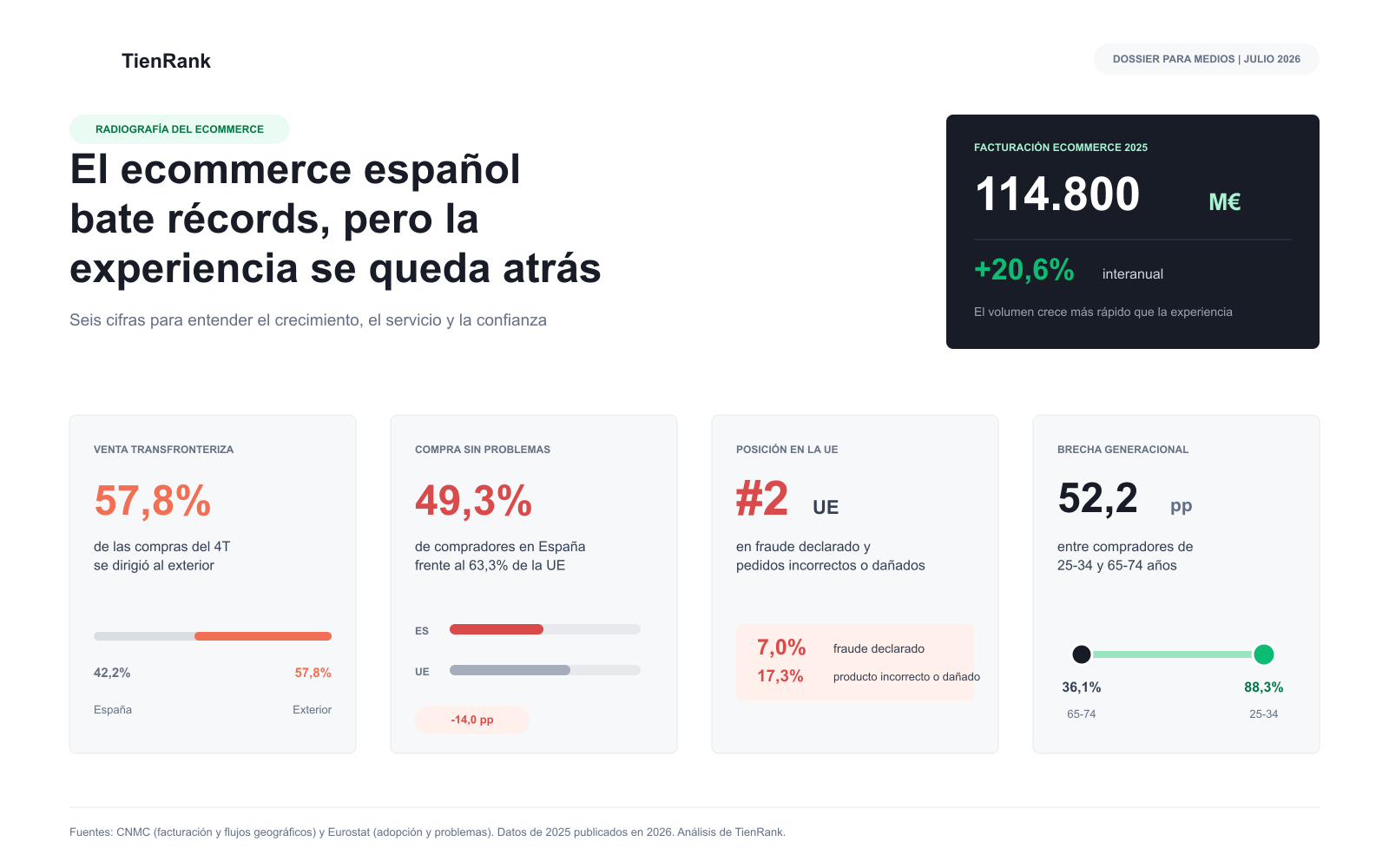
TienRank analyzes the latest comparable CNMC and Eurostat data on e-commerce growth in Spain, shopping problems, generational adoption and cross-border spending.
Executive summary
The full picture
E-commerce turnover with origin or destination in Spain exceeded EUR 114.8 billion in 2025, 20.6% more than the previous year. However, TienRank's analysis of the latest comparable Eurostat data shows a less visible tension: only 49.3% of online shoppers in Spain said they had not experienced any problem in the previous three months, compared with 63.3% across the EU-27.
Spain appears in second position in the EU by share of shoppers reporting fraud problems and also by incorrect or damaged product deliveries. It is third for delays beyond the announced delivery time and fourth for website difficulties, warranty-information problems, unresolved complaints and final costs higher than those indicated.
This result does not mean that Spain has the second largest absolute number of fraud cases. Eurostat measures the percentage of shoppers who report each problem. The research identifies a comparative signal of experience and trust that deserves monitoring, not a judicial measurement of crime.
Results
Six main conclusions
- CNMC recorded more than EUR 114.8 billion in card-based e-commerce transactions with origin or destination in Spain during 2025, a 20.6% year-on-year increase.
- 49.3% of shoppers in Spain said they had not encountered problems, 13.9 points below the EU-27 average.
- 30.2% reported deliveries slower than indicated and 17.3% reported incorrect or damaged products.
- 7.0% reported fraud problems, compared with 3.9% in Europe. Spain holds the second descriptive position in the EU-27 for this indicator.
- 88.3% of people aged 25 to 34 bought online, compared with 36.1% of people aged 65 to 74.
- 57.8% of fourth-quarter revenue came from purchases originated in Spain and made in foreign merchants; 94.6% went to EU establishments.
European comparison
Spain compared with the EU-27
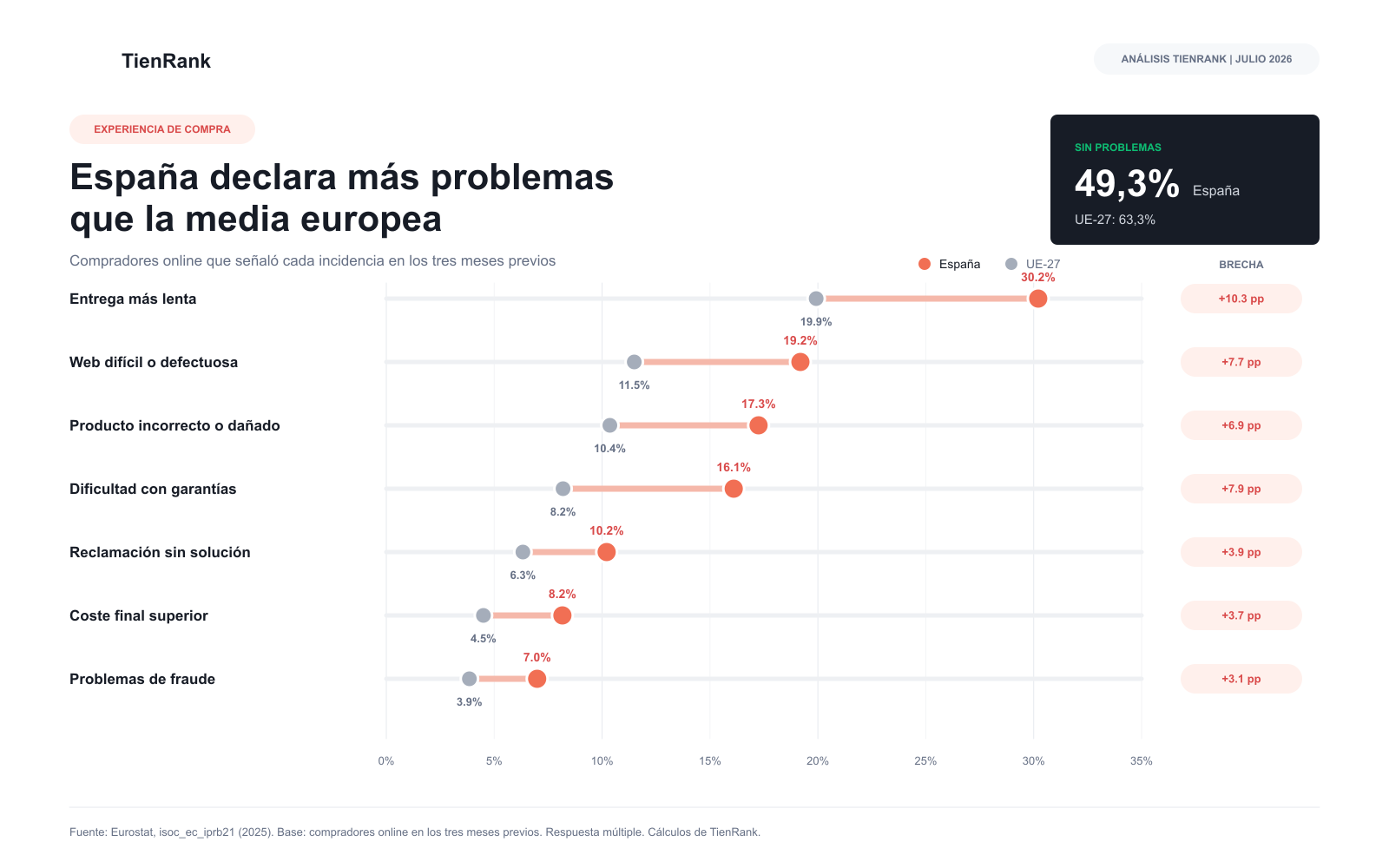
Only 49.3% of online shoppers in Spain said they had not suffered any problem in the previous three months, compared with 63.3% across the EU-27. Spain is above the European average in the seven main problems measured by Eurostat.
The result does not mean that Spain has the second largest absolute number of fraud cases. Eurostat measures the percentage of shoppers who say they encountered each problem. The research identifies a comparative signal of experience and trust, not a judicial measurement of crime.
Shopping experience
Spain reports more incidents than the European average
Percentage of online shoppers who reported each problem during the previous three months.
| Indicator | Spain | EU-27 | Difference | Spain's position |
|---|---|---|---|---|
| Shoppers without problems | 49.3% | 63.3% | -13.9 pp | 5th lowest share |
| Delivery slower than indicated | 30.2% | 19.9% | +10.3 pp | 3rd highest share |
| Difficult or faulty website | 19.2% | 11.5% | +7.7 pp | 4th highest share |
| Incorrect or damaged product | 17.3% | 10.4% | +6.9 pp | 2nd highest share |
| Difficulty finding guarantees or rights | 16.1% | 8.2% | +7.9 pp | 4th highest share |
| Complaint difficult or not answered satisfactorily | 10.2% | 6.3% | +3.9 pp | 4th highest share |
| Final cost higher than indicated | 8.2% | 4.5% | +3.7 pp | 4th highest share |
| Fraud problems | 7.0% | 3.9% | +3.1 pp | 2nd highest share |
Percentages are calculated over people who bought online during the three months before the survey. The same person may select several problems.
Market
Growth has not removed friction
The economic picture is expansive. CNMC puts annual turnover above EUR 114.8 billion, while the fourth quarter reached EUR 31.418 billion. During that period, travel agencies and tour operators concentrated 7.1% of revenue and clothing accounted for 7.0%.
The experience picture is less favorable. Spain exceeds the European average in the seven main problems measured by Eurostat. The distance is especially pronounced in delays, website functioning, incorrect or damaged products and warranty information.
The two sources measure different universes and should not be merged into one single rate. CNMC provides a census of card transactions with origin or destination in Spain. Eurostat uses a harmonized household and individual survey. Reading them together describes one tension: the channel is growing strongly while a high proportion of shoppers still report friction.
Adoption
The gap is not between young shoppers in Spain and Europe
70.8% of Spain's population aged 16 to 74 bought online in the previous twelve months, compared with 73.6% across the EU-27. The overall difference is moderate, but it hides relevant contrasts.
Among 25- to 34-year-olds, Spain reaches 88.3%, almost the same level as the EU-27 at 88.5%. The largest distance appears among people aged 65 to 74: 36.1% in Spain compared with 44.4% in the EU, 55.7% in France and 61.0% in Germany.
Formal education also shows a wide difference: 85.2% of people with higher education bought online, compared with 47.0% of people with low educational attainment. The distance between city and rural areas is smaller: 72.4% versus 68.3%.
These data do not prove that a poor experience directly causes lower adoption among older people or people with less education. They do show that the next stage of growth does not depend only on capturing more traffic: it also requires understandable processes, visible conditions, predictable deliveries and complaints that can be resolved.
Digital adoption
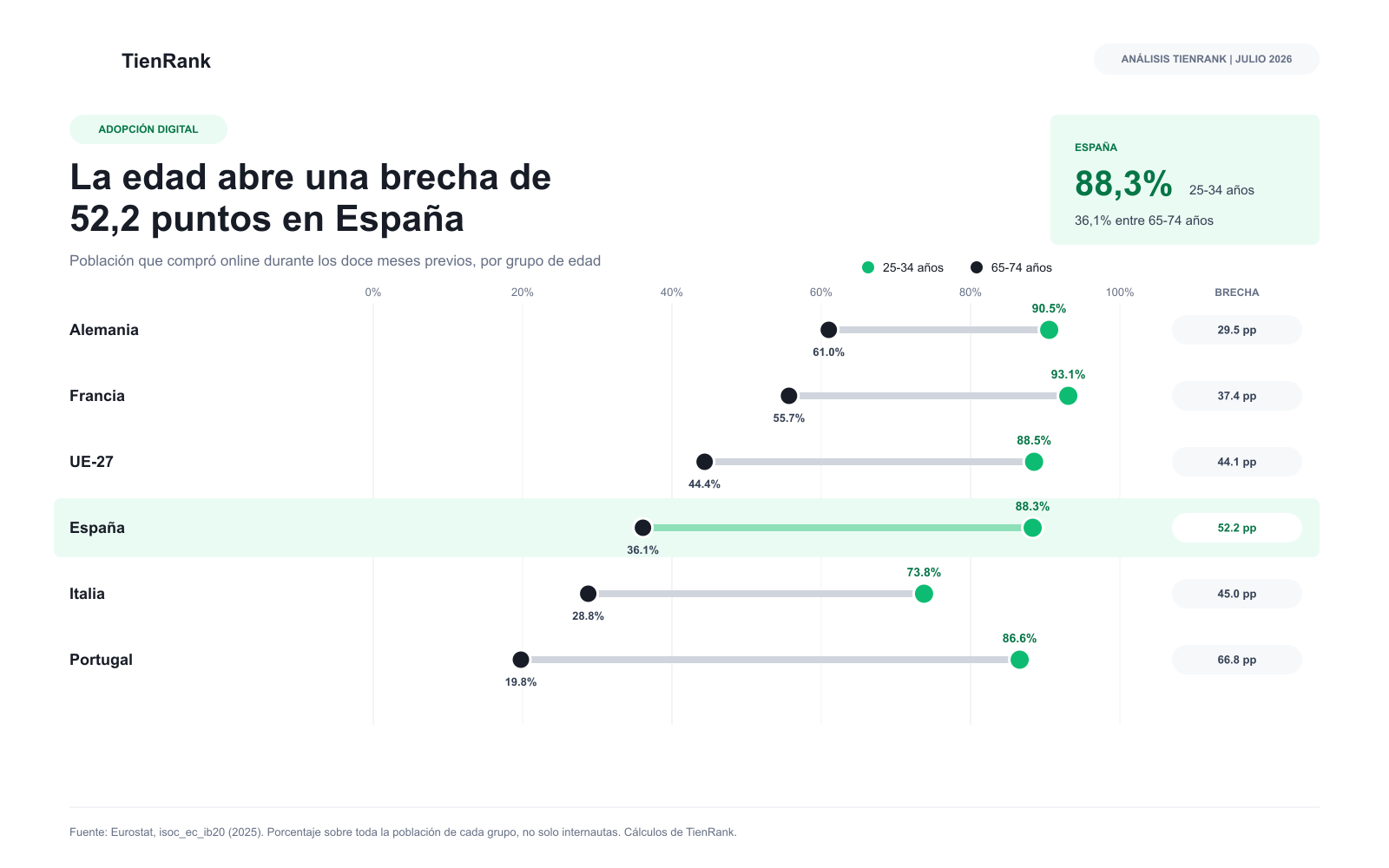
Age opens a 52.2-point gap in Spain
Population that bought online during the previous twelve months, by age group.
| Country | Ages 25-34 | Ages 65-74 | Generational gap |
|---|---|---|---|
| Germany | 90.5% | 61.0% | 29.5 pp |
| France | 93.1% | 55.7% | 37.4 pp |
| EU-27 | 88.5% | 44.4% | 44.1 pp |
| Spain | 88.3% | 36.1% | 52.2 pp |
| Italy | 73.8% | 28.8% | 45.0 pp |
| Portugal | 86.6% | 19.8% | 66.8 pp |
Cross-border commerce
More than half of fourth-quarter spending went abroad
During the fourth quarter of 2025, 57.8% of revenue recorded by CNMC corresponded to purchases originated in Spain and made in foreign merchants. The external net balance showed a deficit of EUR 14.742 billion. Clothing represented 9.9% of the volume purchased from Spain abroad.
The figure does not allow that spending outflow to be attributed to one single cause. Price, variety, availability, brand, marketplaces and convenience may all play a role. It does raise a relevant economic question: how much of digital-consumption growth can merchants established in Spain capture if they do not simultaneously improve their offer and post-purchase experience?
TienRank reading
The challenge is no longer only to sell more
The main conclusion is that the challenge for e-commerce in Spain is no longer only to convince the population to buy online. The market is growing at double-digit rates and younger groups show adoption levels comparable with Europe. The challenge is to turn that growth into a reliable, inclusive and competitive experience for a broader base of shoppers.
The priorities suggested by the data are concrete: realistic delivery promises, order checks, accessible information on guarantees, complete costs before payment, websites that work properly and complaint systems capable of closing the problem.
Media material
Data, angles and editorial contact
The data indicate that the challenge for e-commerce in Spain is no longer just selling more. It is making buying predictable, understandable and resolvable also for people outside the most digitized group. When the market grows by 20% but one in two shoppers reports a problem, experience stops being an operational detail and becomes a competitiveness issue.
David Trotonda, CEO of TienRank
Editorial proposal pending approval. It must not be sent or reproduced as a literal statement until David Trotonda expressly approves it.Editorial angles
- Consumers
- Why record growth has not yet translated into a problem-free shopping experience.
- Companies
- Which incidents online shops should prioritize to compete with foreign operators.
- Economy
- How much digital spending originated in Spain ends up in foreign merchants.
- Inclusion
- The 52.2-point distance between shoppers aged 25-34 and those aged 65-74.
- Fashion
- The weight of clothing in turnover and in purchases made from Spain abroad.
About TienRank
TienRank is an online shop research and discovery platform built in Valencia. The team combines software development, e-commerce strategy and editorial research. David Trotonda, CEO of TienRank, is available for interviews about the findings, their impact on retailers and the customer-experience improvements suggested by the data.
Transparency
Methodology
- Analysis closing date: July 17, 2026.
- Adoption: Eurostat isoc_ec_ib20, 2025 survey, percentage of the total population in each group aged 16 to 74 that bought online during the previous twelve months.
- Problems: Eurostat isoc_ec_iprb21, 2025 survey, percentage of people who bought online during the previous three months.
- The European survey is based on approximately 172,000 households and 330,000 people. Most countries collected the information during the second quarter of 2025.
- Educational levels follow ISCED 2011: low, up to lower secondary; high, tertiary education.
- Spain's positions were calculated by ranking the available values for the 27 Member States. They are descriptive positions and do not incorporate sample confidence intervals.
- Economic context: CNMC e-commerce statistics for card transactions with origin or destination in Spain. Fourth-quarter and full-year 2025 data were published on July 3, 2026.
- All calculations are preserved in CSV and JSON inside the downloadable press kit.
Limitations
- Problems are reported by surveyed people and are not individually verified incidents.
- Fraud problems do not equal a police report, conviction or confirmed fraud.
- Responses are multiple and do not represent the percentage of affected orders.
- Eurostat and CNMC use different methodologies, denominators and scopes.
- The analysis is descriptive and does not establish causality between age, education, problems and e-commerce use.
- CNMC data focus on credit-card and debit-card transactions and do not represent every possible payment method.
Reproducibility
Sources and files
How to cite this study
TienRank (2026). E-commerce in Spain breaks revenue records, but the shopping experience still lags. Analysis of CNMC and Eurostat data for 2025.
URL: tienrank.com/en/investigaciones/ecommerce-espana-experiencia-compra-2026

David Trotonda
CEO y fundador de TienRank. Software, strategy and e-commerce research from Valencia.
View author page